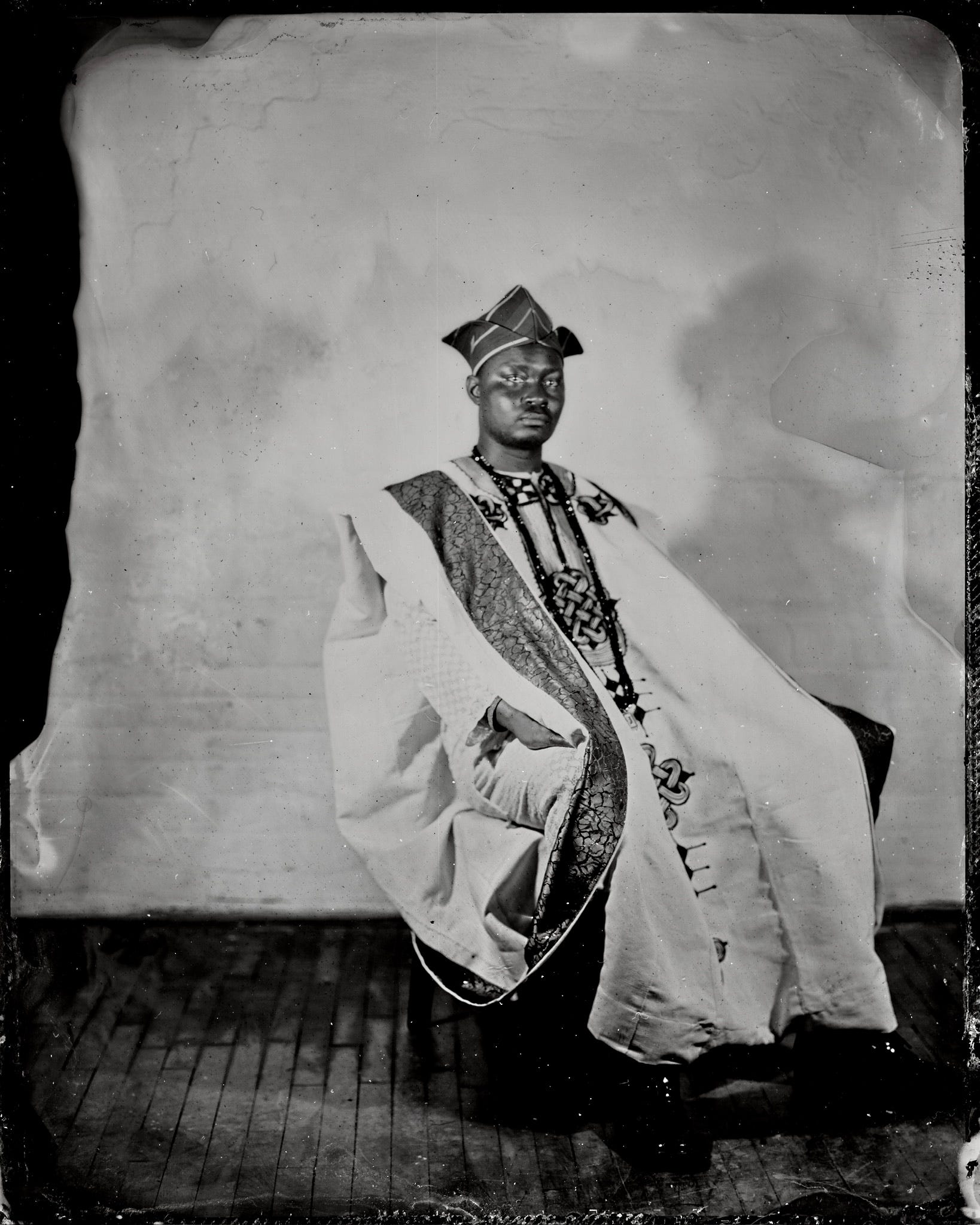
Let’s go down memory lane.
It’s the 1850s, and memory itself is expensive. The only people who could afford to be remembered were those who could afford silver and glass—silver for daguerreotypes, glass for ambrotypes.
So if you were poor, enslaved, newly freed, or newly immigrated, your image rarely entered the visual record. Your friends knew you existed. Your family knew you existed. But history didn’t.
You lived, but you did not archive.
It’s obviously a lot different now. We have phones, tablets, and infinite storage. Everything lives in servers and clouds—weightless, untouchable, anchored nowhere. Our images are everywhere and nowhere at the same time. And that’s the first difference: presence, weight, durability.
My father left when I was about two weeks old.
And no—you are not here for me to trauma-dump. I promise you, there’s a point. He didn’t go to grab a carton of milk. He didn’t go to grab a pack of cigarettes. He left to provide.
He came to the United States. He worked, and worked, and worked. He sent money back home so we could eat, so we could have shelter, so we could go to good schools. In many ways, I lived on the sacrifices of my parents, so all I had of him were photographs. And all he had of us—because there was no FaceTime, no Skype—were photographs. My mother mailed him images of birthdays, of small gatherings, of moments that tried to stand in for presence.
Now that I’ve learned this process, I sometimes think: at the age of two, three, four, five, six—what I would have given to hold a small metal plate in my hands with my father’s face on it. It wouldn’t have mattered how big or how small. If small, something I could carry with me; if large, something I could look up to. Someone I hadn’t seen, but someone who shaped my life through sacrifice—through his hands and through his absence.
Tintype didn’t just make a democracy out of memory. It also romanticized it.
Imagine it’s the 1850s. Your partner is away at war, and all you have is a small metal plate with their likeness on it.
Or imagine being on the battlefield. You have your dog tags, but you also have a small locket with your wife’s face pressed into metal.
In the 1850s, a tintype was a Black man in uniform—photographed as a soldier; a woman seated upright, photographed as an individual choosing how she would like to be seen; a family gathered—declaring themselves a unit in a society that denied them that legitimacy.
The tintype set existence in stone—or, in this case, on metal. Likeness became an object. A fact. A thing that could be held. A collectible not just for you, but for your children—and their children—and theirs. So that if it ever went dark—and yes, this is for the conspiracy theorists—someone could say with certainty that you existed.
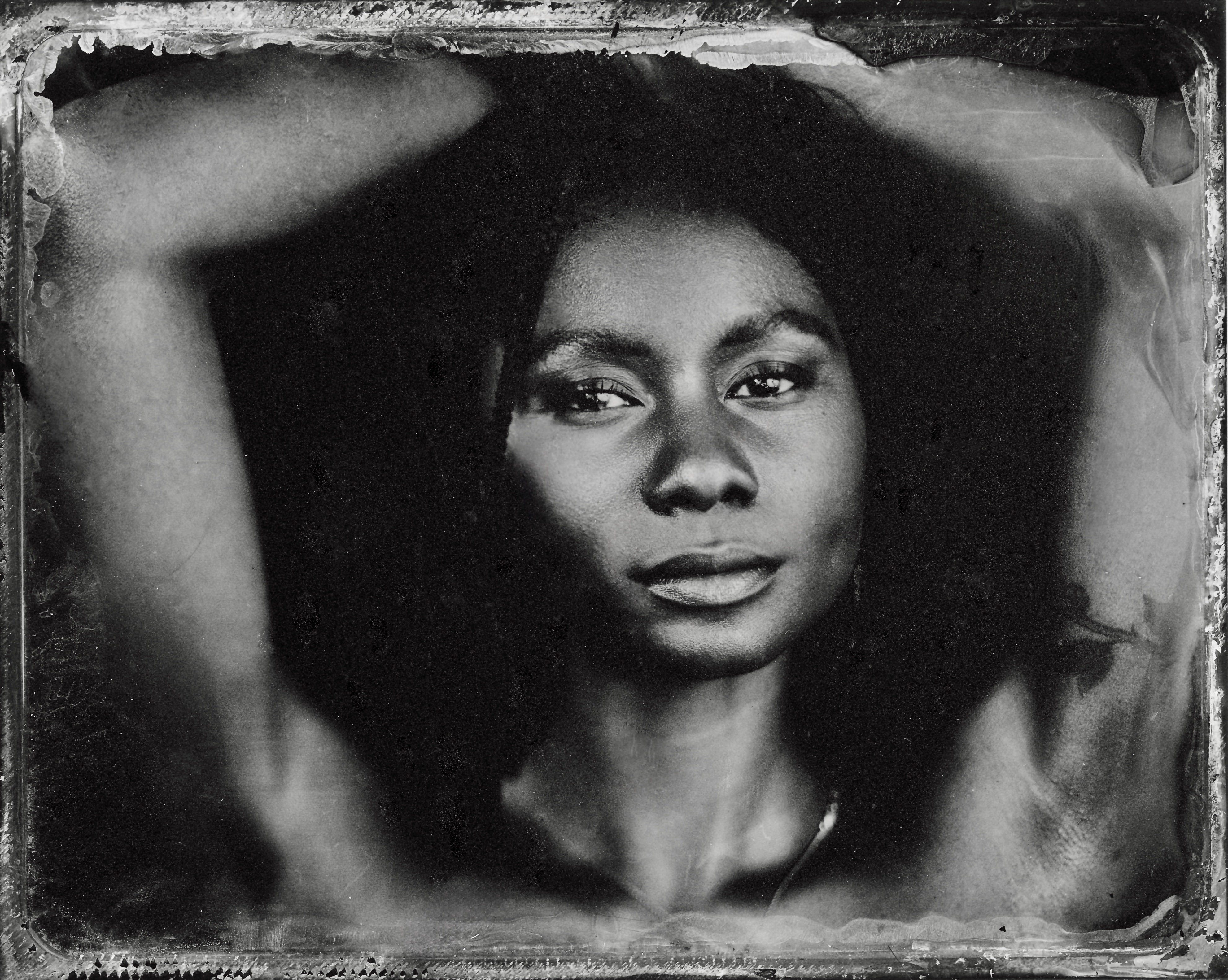
Tintype is a moment in time. There is no negative, just a positive plate—a positive moment and a positive truth. Durable and indestructible in ways glass isn’t.
Because tintypes were inexpensive and mobile, people long excluded from formal record-keeping—Black families, laborers, migrants—could finally be documented. Many of the earliest surviving photographs of Black Americans exist because tintype existed.
And sure, tintype doesn’t say, here’s everything. It doesn’t do what video does. It doesn’t do what a thousand images from different angles can. Tintype stops time and declares:
“This moment mattered enough to stop time!”
So if you ever find yourself sitting in front of my camera, that’s what we’re documenting—that you, in that moment, matter enough to stop time, to go slow with it.
For Black families especially, these metal plates are a refusal to outsource memory. For my family, sitting for a portrait is equivalent to declaring that we will not wait for institutions to remember us. We will remember ourselves. That’s what it’s always been.
Tintype insists that families—especially marginalized families—deserve permanence. Not perfection. Just presence.
I don’t know what kind of luck—or preparation—it takes to stand next to a master, watch a technique unfold, and recognize the buildup of passion before it becomes language. To see it and say, this is it. “This is how I want to document people.” “This is my medium.”
I don’t know how it happened. I just know that curiosity met opportunity. Attention met timing.
And because I was there—because I was looking—I became one who could make these images.
So that years from now, if I have a child… so that years from now, my brother’s kids can hold something real in their hands and say: This is where we came from. This is proof.
A tintype begins as a thin sheet of iron, lacquered black. Onto that surface, I pour collodion—a solution of nitrocellulose suspended in ether and alcohol. It spreads by gravity and sets by evaporation.
While the collodion is still tacky, the plate is submerged in silver nitrate, where it becomes light-sensitive. Silver halides form, allowing the plate to react to light.
The plate goes into the camera while wet. Exposure happens in seconds. Light strikes silver. A latent image is formed—still invisible.
Back in the dark, I develop the plate, usually with an iron-based developer. Silver ions are reduced to metallic silver. The image appears slowly—almost like magic.
Then I fix it, wash it, dry it, and seal it.
Light turns into matter.
Every plate carries evidence of the conditions under which it was made: temperature, humidity, chemistry ratios, the steadiness of the pour, the stillness of the sitter. Every plate is a perfect record.
So when I say we’re stopping time, I mean it literally.
That is the way I’d like to photograph you and those I love.
That’s how memory becomes permanent.